Stock Market Education

Best Forex Trading Course in Delhi: 7 Things to Check

Finding the best Forex trading course in Delhi is not simply about choosing the institute with the lowest fees, the longest curriculum or the biggest claims about trading results. A good Forex course should help beginners understand how currency markets work, analyse charts, develop trading strategies, manage risk, practise market analysis and review their decisions.

Best Forex Trading Course in Delhi: 7 Things to Check Read More »
12 Intraday Trading Setups for Beginners

Intraday trading setups are predefined market conditions that traders watch for before considering a trade. Instead of buying simply because a stock is rising or selling because a candle looks bearish, a trader using a defined setup waits for specific conditions involving price action, market structure, volume, support and resistance, VWAP, moving averages or other

12 Intraday Trading Setups for Beginners Read More »

Delivery Trading vs Intraday Trading: Differences, Examples, Risks & Which Is Better for Beginners

Quick Answer: Delivery trading involves buying shares and holding them in your Demat account for the long term, making it ideal for wealth creation and lower stress. Intraday trading involves buying and selling stocks within the same trading session for short-term gains, requiring active monitoring and high risk tolerance. Beginners should generally master delivery trading

Delivery Trading vs Intraday Trading: Differences, Examples, Risks & Which Is Better for Beginners Read More »

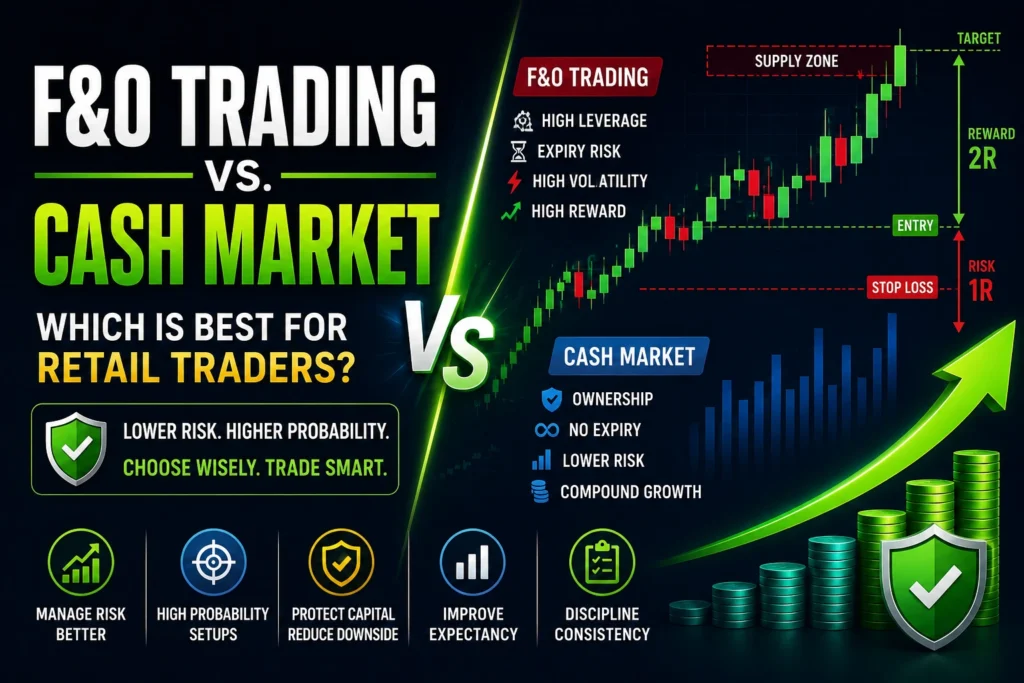
F&O trading vs cash market comparison showing leverage, expiry risk, stock ownership and lower-risk trading for retail traders

Cash Market vs Futures and Options: Key Differences

The main difference between the cash market and Futures & Options (F&O) is what you actually trade. In the cash market, investors can buy actual shares of listed companies. When shares are purchased for delivery and settled, they are held in the investor’s Demat account. In F&O, traders deal in derivative contracts whose value is

Cash Market vs Futures and Options: Key Differences Read More »

Options vs Stocks India comparison infographic showing options trading and stock investing for generating regular income with key risks and benefits.

Options vs. Stocks: Which Is Better for Regular Income in India? (Complete Comparison)

Quick Answer: For generating regular, sustainable income in India, stocks (through dividends, swing trading, and positional delivery) are better suited for beginners and long-term wealth builders. Options offer higher leverage and active cash-flow potential, but require advanced risk management, technical expertise, and substantial capital—making them suitable only for experienced traders. Key Takeaways Introduction The pursuit

Options vs. Stocks: Which Is Better for Regular Income in India? (Complete Comparison) Read More »

Futures and Options Basics guide featuring derivatives market growth, stock charts, leverage, risk management, and F&O trading concepts in India.

Futures and Options for Beginners: Complete F&O Guide

Futures and options, commonly called F&O, are financial derivatives whose value is linked to an underlying asset such as a stock, index, commodity or currency. They can be used for trading, hedging and managing market exposure, but they are more complex than simply buying shares for delivery. F&O introduces concepts such as: For beginners, the

Futures and Options for Beginners: Complete F&O Guide Read More »

Option chain explained showing Open Interest (OI), support, resistance, PCR, and IV in NSE options trading.

Option Chain Explained: How to Read Open Interest (OI) Like a Professional Trader

Featured Answer: An option chain is a comprehensive matrix displaying all available Call (CE) and Put (PE) option contracts for a specific underlying asset across various strike prices and expiries. It highlights crucial metrics like Open Interest (OI), Change in OI, Volume, and Implied Volatility (IV). Professional traders use the option chain to gauge market

Option Chain Explained: How to Read Open Interest (OI) Like a Professional Trader Read More »

risk management options trading illustration showing capital protection strategies, position sizing, disciplined trading, and portfolio growth in derivatives trading.

Risk Management Options Trading: 11 Rules to Avoid Catastrophic Losses

You are sitting at your desk on an expiry Thursday. The market is churning, the order book is flickering, and the Nifty 50 derivative chain is moving at a speed that makes your pulse quicken. You see a setup that looks like a high-probability win. You calculate the potential payout, imagine the profit hitting your

Risk Management Options Trading: 11 Rules to Avoid Catastrophic Losses Read More »

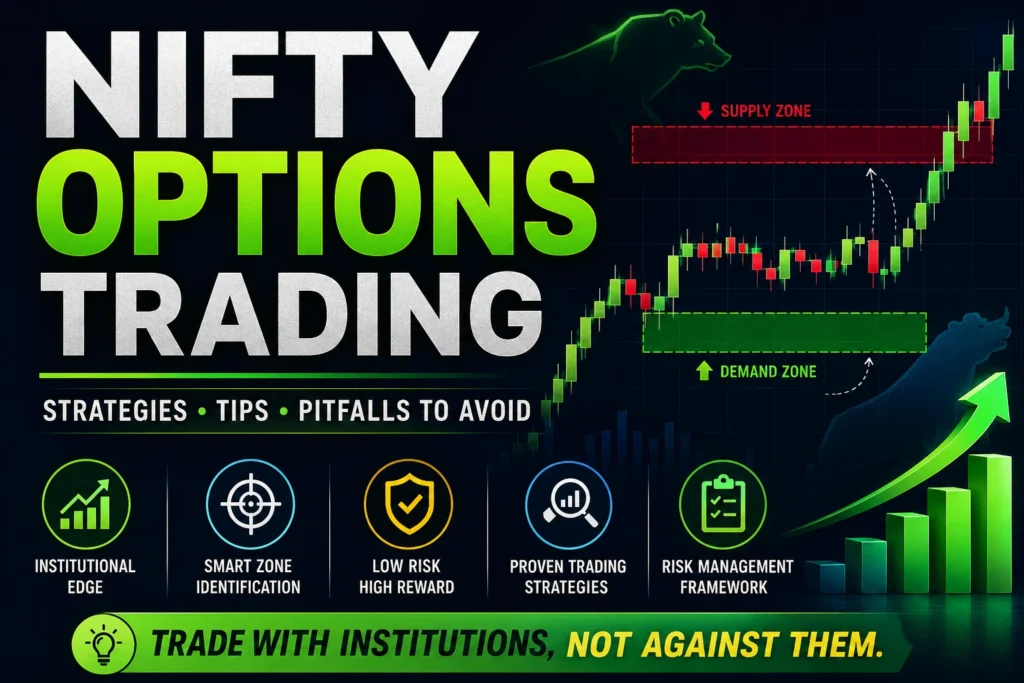
Nifty options trading guide featuring option chain analysis, supply and demand zones, institutional trading strategies, and risk management concepts.

Nifty Options Trading: Strategies, Tips, and Common Pitfalls to Avoid

You sit in front of your dual-monitor setup at 9:14 AM. The pre-market equilibrium is settling, and institutional order books are quietly loading up. At exactly 9:15 AM, the opening bell rings, and the derivative chains violently spring to life. Welcome to the premier battleground of the Indian financial markets. For the modern retail participant,

Nifty Options Trading: Strategies, Tips, and Common Pitfalls to Avoid Read More »

Options trading India guide featuring Nifty options, call and put contracts, SEBI rules, margins, and beginner trading strategies.

Options Trading Rules in India 2026: Margins, Expiry & SEBI Rules

Options trading in India operates within a regulated exchange-traded derivatives framework. Traders need to understand not only calls, puts and premiums, but also current rules covering margins, contract sizes, expiry schedules, settlement, position limits and broker requirements. This matters because India’s equity-derivatives framework has changed significantly in recent years. SEBI has introduced measures relating to

Options Trading Rules in India 2026: Margins, Expiry & SEBI Rules Read More »